
Managing groundwater and fluid risk across the GCC
Water doesn’t wait. Neither do we.
For over 30 years, ACTION has set the global benchmark for managing groundwater and fluid risk across the GCC, in construction, oil and gas, industrial and municipal work: dewatering deep excavations, bypassing live networks, pre-commissioning pipelines and supporting plant shutdowns.
Groundwater rising under an excavation. A live sewer that can’t be switched off. A pipeline that has to pass its test. A shutdown window measured in hours.
Our engineers design the solution. Our own fleet and crews deliver it. AURA (ACTION Unified Real-Time Assurance), our operational assurance platform, predicts and prevents issues before they reach your programme, network or plant, with our engineers deciding every response.
For project owners, authorities and operators, that means one partner carrying the fluid risk from first assessment to final handover. Fewer gaps for it to fall through, one party accountable when conditions change, and a programme built to stay on track.
30+
Years in GCC
8000+
Projects Delivered
6,000+
Specialised Assets
Construction, Industrial Services and Municipal
What is fluid risk?
Small changes in the water can hold up the whole programme.
Fluid risk is the risk that water or other fluids delay construction, interrupt essential services or stop industrial operations. It covers groundwater and stormwater, flows in live sewer and water networks, pipeline test water and the nitrogen used to purge and inert lines, and process and produced water in operating plants. ACTION manages it across the GCC with in-house engineering, its own fleet and crews, and AURA on connected assets.
Uplift beneath a basement slab. A bypass that can’t keep up with the peak flow. Test water with nowhere compliant to go. A line that won’t reach its dew point. A shutdown that overruns.
Fluid scopes are often planned late and bought on price, because they look like support work for the main job. Then the ground behaves differently from the report, the network carries more than the survey showed or the test fails, and the whole programme waits
How is managing fluid risk different from buying a fluid service?
From a single task to the whole programme.
Managing fluid risk means looking at every way water and other fluids can affect a programme, network or plant, and controlling them together. Dewatering an excavation, bypassing a sewer or hydrotesting a pipeline each controls one part of that risk.
| A single fluid service | Fluid risk control | |
|---|---|---|
| Focus | One task: dewatering an excavation, bypassing a sewer or testing a line | Every way water and other fluids can affect the programme, network or plant |
| Starts | When the task is awarded | At design, while key decisions can still change |
| Scope | The task itself | Connected scopes, from engineering to close-out |
| Accountability | Often shared across several contractors | One ACTION team |
| Record | Task records | One continuous operational record, with AURA on connected assets |
ACTION delivers single services and full scopes. Either way, our engineers look at the wider risk the service sits in.

Why does fluid risk get missed?
Four common causes. All preventable with the right approach.
Fluid risk usually gets missed for four reasons: conditions are misread, the fluid scope comes in too late, the design assumes one set of conditions, or the work is split across too many handovers. In 30 years on GCC sites, networks and plants, ACTION has seen all four, and each one is preventable.
1. Conditions are misread.
Ground conditions can change within metres, and permeability, which decides how quickly water moves through soil and rock, can vary significantly across a single site. A sewer can carry more flow than the survey suggested. Line data or process conditions can differ from the drawings. A design built on the wrong reading means the wrong system. We verify conditions before committing to a design: permeability and pumping tests on the ground, flow data on the network, and the line data and owner’s specification on pipelines and plant.
2. The fluid scope comes in too late.
By the time groundwater control is awarded, the excavation depth and retention method may already be fixed. By the time a bypass is planned, the isolation date may be set. By the time pre-commissioning is scoped, the commissioning date may be close. The design ends up working around decisions it should have helped shape. We get involved early, while there’s still room to make the right calls.
3. The design assumes one set of conditions.
Tides, rainfall and seasonal groundwater shift. Network flows peak and storms arrive. Summer heat changes how equipment performs. A system designed for a single scenario has no margin to respond. We model a range of conditions at design stage, then check live data against the model once the system is running.
4. Too many handovers.
When different companies handle design, equipment, installation and operation, important details can get lost between them. On a pipeline, the gap can open between the team that fills and tests the line and the team that dries and inerts it. Our Turnkey Delivery approach keeps the job connected, with one accountable team from start to finish.

What happens when fluid risk isn’t controlled?
The smallest problem can have the biggest knock-on effect.
Uncontrolled fluid risk leads to programme delays, lost production, rising costs, contractual exposure, and interruptions to public services.

Programme delays
Flooded excavations, foundations on hold, failed tests holding up commissioning, and handovers pushed back while everyone waits.

Lost production
Shutdowns and turnarounds that overrun, and plants that stay offline longer than planned.
Rising costs
Additional equipment, remedial work, idle crews and extended programmes that cost far more than the original fluid scope.
Contractual exposure
Delays can lead to claims, disputes and difficult conversations between contractors, owners, operators and project teams.

Service interruptions and public impact
Sewage overflows, interrupted water supplies, flooded roads, non-compliant discharge or settlement affecting nearby buildings.
Why do project owners trust ACTION with fluid risk?
The risk, the tools and the team, held in one business.
Project owners trust ACTION with fluid risk because one business holds every part of the answer: the engineers who read the conditions, the fleet and workshop that deliver the solution, AURA to predict and prevent issues, and the people who stay with the job until it is done. Together, they are how ACTION keeps programmes, networks and plants on track.
What it means for project owners
Certainty and value. Earlier visibility of fluid risk, a design optimised before it is built, equipment ready when the programme calls for it, and one partner accountable from design to close-out. That is how fluid risk stays off your critical path.
Where does fluid risk show up?
Seven specialist services. One accountable team.
Fluid risk shows up wherever water or other fluids meet a programme, a network or a plant. ACTION manages it across three sectors, Construction, Industrial Services and Municipal, through seven specialist service lines. Industrial Services covers Pipeline & Process, Industrial, Environmental and Marine & Offshore, and Rental & Sales supplies equipment across all three.
Fluid risk looks different on every job. On every one, we work to the same principles: understand the conditions, design the right solution and stay in control.

The Risk:
Groundwater entering an excavation, uplift beneath a slab or settlement affecting neighbouring structures.
Our Approach:
We model the ground, design the right system and operate it until the structure can safely resist groundwater pressure.
Services:
Ground dewatering (deep wells, wellpoints, ejector wells and sump pumping), discharge treatment, fluid transfer (overpumping and bypass pumping), sheet piling and shoring, monitoring and control (AURA), permeation grouting, ground anchors, hydrodemolition, system flushing and HDPE works.
In practice:
Groundwater control for the Palm Jumeirah vehicular tunnel.
The risk:
A failed commissioning test, delays to start-up or test water that can’t be discharged to standard.
Our approach:
We pre-commission to the project specification and acceptance criteria, from cleaning and pigging, gauging and filling, through hydrotesting and drying, to nitrogen purging and inerting, with test pressures, temperatures and hold periods on the record and the work run under ACTION’s HSE controls.
Services:
Pipeline cleaning (pigging and chemical), gauging and filling (flooding), hydrotesting, dewatering, air blowing and drying, filtration and disinfection, flange management, leak testing, and nitrogen purging and inerting.
In practice:
Flushing and commissioning a 48-inch subsea pipeline off Fujairah.
The risk:
Shutdowns and turnarounds that overrun, extending downtime and affecting production.
Our approach:
We plan our scope with the operator’s shutdown team before the window opens, then mobilise and sequence the work so it finishes inside the shutdown window.
Services:
High-pressure cleaning (hydrojetting), heat exchanger bundle cleaning, tank cleaning, tank testing and monitoring, surface preparation and hydrodemolition.
The risk:
Network interruptions, sewage overflows or flooding that affects communities and public services.
Our approach:
We keep water and wastewater moving during repairs and maintenance, with standby capacity designed in. ACTION has partnered with major municipalities across the region on their heavy-rain and flood mitigation programmes, designing, supplying and operating the pumps and systems. AURA monitors and predicts where connected pumps need attention, so our engineers can act as soon as the weather turns.
Services:
Sewerage bypass pumping, stormwater and drainage bypass pumping, seawater intake, pipeline shutdown dewatering, HDPE works, flood emergency response, utility line leak and pressure testing, chlorination and disinfection, and monitoring and control (AURA).
In practice:
Sewage overpumping during municipal works in Dubai, and emergency response during the April 2024 UAE floods.
The risk:
Water that fails its discharge permit, reuse or supply specification, with regulatory, environmental and operational consequences.
Our approach:
Whether water is leaving a site or feeding a process, it has to meet the standard. We assess what’s in the water, engineer the treatment and verify the treated water against the discharge permit, reuse or supply specification, with a clear record to prove it.
Services:
Desalination and reverse osmosis, suspended solids treatment, groundwater remediation, phase separation, industrial treatment, and produced water and wastewater treatment.
In practice:
ACTION dewatered 5.3 million cubic meters of seawater trapped within the cofferdam in only 45 days in preparation for construction.
The risk:
Restricted access, changing sea and weather conditions, and hazardous environments where conventional methods may not be suitable.
Our approach:
Our offshore technicians and engineers select the methods and equipment for each environment, and supervise the work themselves.
Services:
Vessel ballasting, marine growth removal, cold cutting, hydrodemolition, surface preparation and equipment sea fastening.
In practice:
Seawater overpumping, pressure testing, and Hypersaline water blended with seawater through twin 1,000mm diffuser pipes.
The risk:
Equipment shortages or failures that bring work to a standstill when time matters most.
Our approach:
The equipment is already in position, so availability isn’t your risk. More than 6,000 assets, the region’s largest specialised fleet, held in depots across the GCC and maintained in our own workshops. Available on dry hire or with ACTION operators, with specialists who match each unit to the duty.
Services:
Pumping, storage, power and air, lighting and filtration solutions, tube bundle cleaning equipment, and sales, fabrication, assembly and maintenance services.
How does ACTION control fluid risk?
One team. Every stage. Full accountability.
ACTION controls fluid risk through four connected stages, Consult, Engineer, Deliver and Control, run by one team that holds the engineering, equipment, people and operational assurance in-house.
Consult
We get involved early, while the ground, the network or the process can still shape the plan. We review the site, the line data or the shutdown scope against 30 years of ACTION operating knowledge.
Engineer
Our engineers and hydrogeologists verify conditions, model the risks and design a solution that works in practice, from dewatering systems and bypass hydraulics to pre-commissioning procedures and treatment. Our engineering workshop prepares the equipment to match.
Deliver
Our own fleet and crews mobilise, install, operate and maintain the system for as long as the job needs it, whether that's an excavation, a live network, a pipeline or a shutdown.
Control
We keep the system performing to the design, then decommission it and hand over the records.
AURA runs across all four stages. On connected assets, it predicts where intervention is needed, so our engineers prevent issues before they escalate, and every reading, alert and response is recorded through to close-out.

How does AURA prevent fluid risk?
Engineering oversight, informed by actual site performance.
AURA predicts and prevents fluid issues across connected assets, under the supervision of qualified ACTION engineers. It verifies equipment is ready, measures live conditions against limits our engineers set and predicts where intervention is needed, so issues are prevented before they reach the programme, network or plant.
A storm is approaching. Water levels are changing. A pump is working harder than expected. Small changes that can add up to a big problem.
AURA brings live data from pumps, generators, piezometers, flow meters, level, pressure and rain sensors, CCTV, vehicles and site teams into one operating picture, and more, depending on the scope. It builds on ARMS, the ACTION Remote Management System, and the operating history recorded on ACTION projects over many years.
Before a pump is called on, AURA verifies it’s ready, including remote rotation testing, so nobody drives out just to check. Maintenance is planned on actual runtime and condition, and our engineers calibrate and optimise each system against what it was engineered to deliver. Our qualified engineers read what AURA shows and decide every response, within the project’s engineering and safety controls.
You don’t manage AURA. You get what it delivers, through your ACTION project reporting: verified readiness, earlier intervention and a clear operational record.
Who manages fluid risk on an ACTION project?
Experience earned on site.
ACTION’s own people manage fluid risk on every ACTION project: a workforce of more than 1,500, most of them on site. Operators, technicians, mechanics and crews install and run the systems, led by our engineers, hydrogeologists and project managers.
Our engineers know the ground, the network and the process. Our workshop teams know the equipment. Our crews know the site, and the sound of a pump that isn’t running quite right.
AURA predicts where intervention is needed. Experience makes the call.
When something changes at 3am, our people are already on it.
What does fluid risk control look like in practice?
Sometimes, better engineering means doing less.
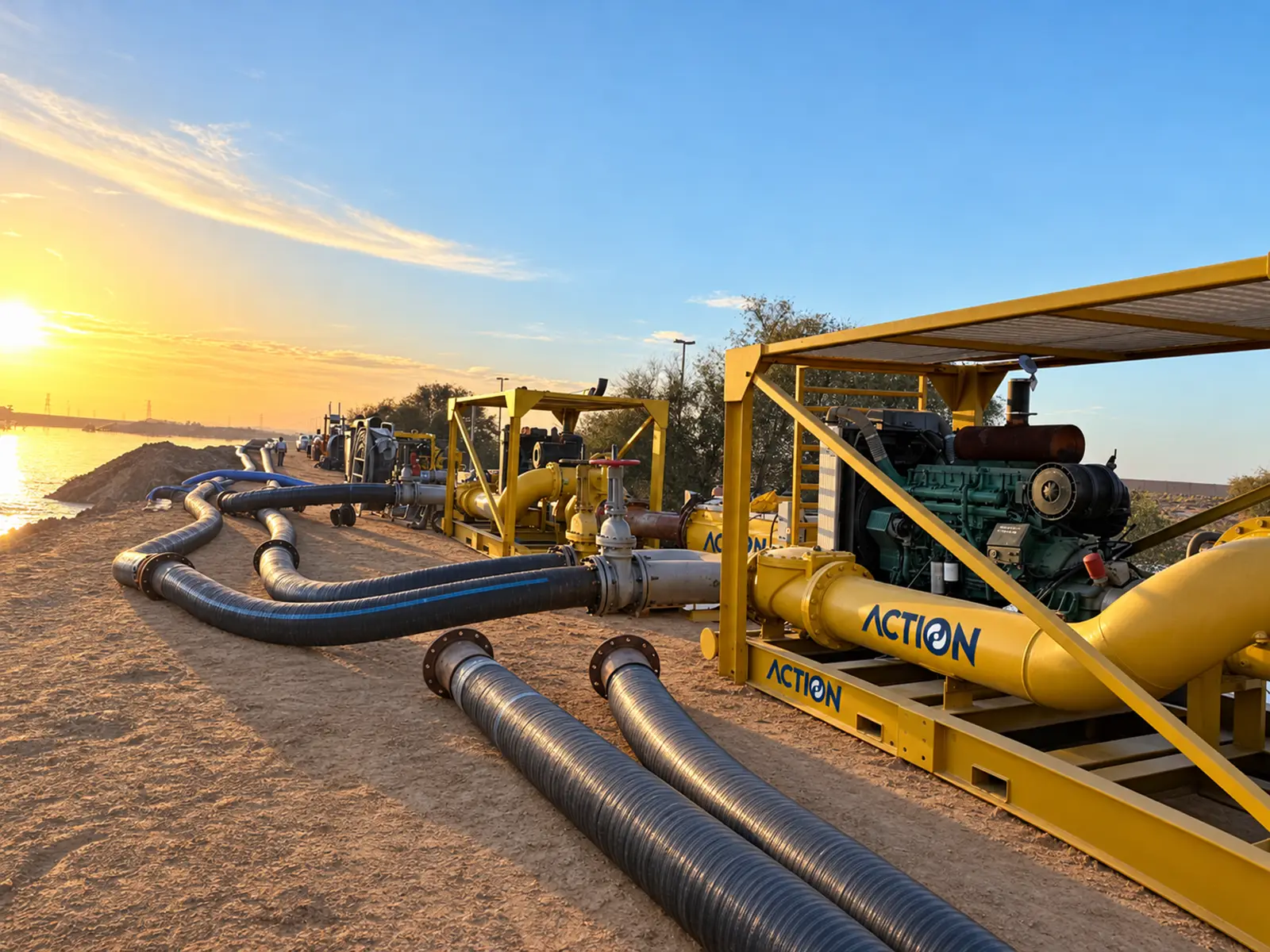
In practice, fluid risk control often means designing the smallest system the evidence supports, and having the right resources in place before they’re needed. ACTION engineers use modelling, site evidence and continuous monitoring to size each system to what the conditions actually require.
More wells and bigger pumps aren’t always the answer.
Three examples from different kinds of work show the same approach.
What does fluid risk control mean for each stakeholder?
One accountable partner. Clear evidence of performance.
| Stakeholder | What ACTION provides |
|---|---|
| Project owners, authorities and operators | Certainty on programmes, networks and plants that cannot afford to go wrong. One accountable partner carrying the fluid risk from design to close-out, a design optimised before it is built, and AURA predicting and preventing issues under engineering supervision, with the results in ACTION’s project reporting. |
| Main, EPC and enabling contractors | Fluid risk taken off your programme. Assets ready to mobilise from our own depots, one contract from design to close-out, readiness verified through AURA, and 30 years of delivery on complex scopes. |
| Specialist service partners | The range and availability you need when your client’s window opens. Maintained equipment on dry hire or with ACTION operators, technical support behind it, and clear terms on every scope. |
| Consultants and technical advisers | A method you can defend. Designs by in-house engineers and hydrogeologists, evidence from comparable projects before you write the specification, and an operational record linking design intent to performance on site. |
For procurement and commercial teams in each of these organisations: a defensible appointment, with one accountable party for the fluid scope, verified availability, clear terms and an auditable record of delivery.
What should you ask before appointing a fluid risk partner?
Seven questions worth asking before the work begins.
Before appointing a dewatering, bypass, pre-commissioning or shutdown contractor, ask how conditions have been verified, how the design handles change, who carries the risk between stages and what happens when a limit is reached. The right questions early can prevent difficult problems later.
- 1What do the site investigation, network survey or line data tell us, and where are the gaps?
- 2
Have conditions been verified on site?
- 3Has the system been designed for changing conditions, from tides and rainfall to peak flows and summer heat?
- 4
Who designs, who supplies, who operates, and who carries the risk between them?
- 5
Is the equipment maintained, tested and ready to mobilise?
- 6What will be monitored, and what happens when a limit is reached?
- 7Who takes responsibility when conditions differ from the design?
At ACTION, these are the questions that shape our engineering approach and how we manage risk on site.